When a conversational interface helps, and when it doesn't.
Alternative Fonts:
Font Size:
The hypothesis
In 2019, we prototyped a chatbot for an automotive eCommerce platform. The assumption: conversational UI
would reduce friction in complex vehicle discovery and quoting tasks.
We were wrong, but the failure revealed something very interesting.
What we tested
Users could complete core tasks (search, filter, get a quote) either through traditional UI or via a
conversational assistant connected to our platform services.
Some were standard prototypes (Wizard of Oz) some were more advanced, with simulated AI capabilities (Google
at the time gave access to a dedicated tool for free).
What we found
With the chatbot, users were faster and made fewer errors. But when asked their preference, the majority
chose the traditional interface.
The efficiency was undeniable. The satisfaction wasn't, we took away the pleasure of discovery.
Only users with an extremely precise idea of what they were looking for were more favourable to the chatbot,
but it’s worth considering than, in other studies, we found that part of the panel with a precise goal,
changed their mind if they find something more interesting that they didn’t consider before.
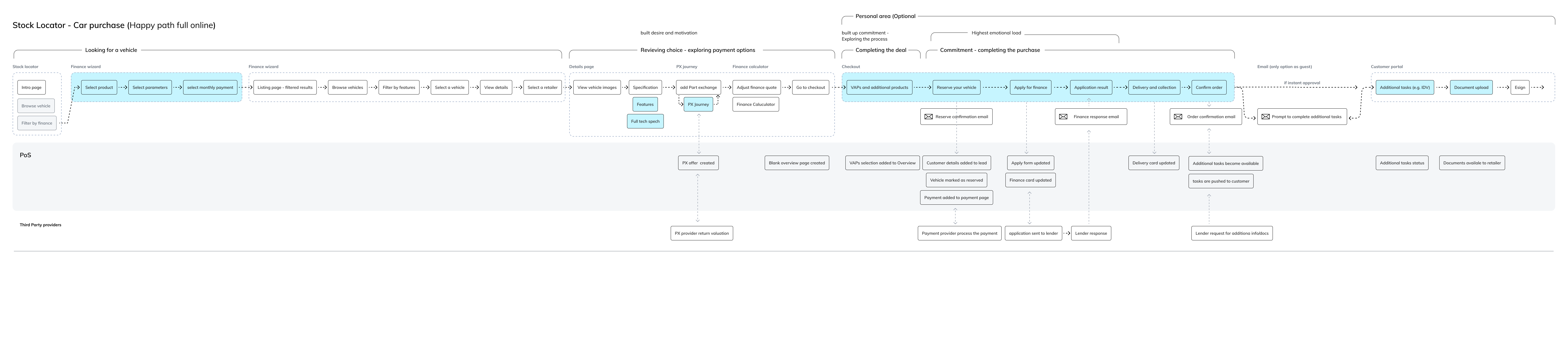
A service blueprinting of the journey we considered (happy path
online only). In light blue the sections that can benefit more from a conversational approach. View full size ↗
The insight
The chatbot succeeded at the behavioural level, task completion, speed, accuracy, but it frustrated the
reflective level because users felt overly guided, less in control. The structured conversation removed the
sense of agency that browsing provides.
This created a clear design principle: conversational UI suits tasks that are infrequent, emotionally dense,
and benefit from guidance — not exploratory tasks where users want autonomy.
How we applied it
We redirected conversational patterns toward linear, high-stakes tasks:
Reservation journeys - where commitment anxiety benefits from reassurance.
Trade-in flows - where step-by-step guidance reduces cognitive load.
Finance applications - where form fatigue is highest.
For discovery and browsing, we preserved traditional UI with progressive disclosure as well as the option to
choose a traditional form once in the transactional part.
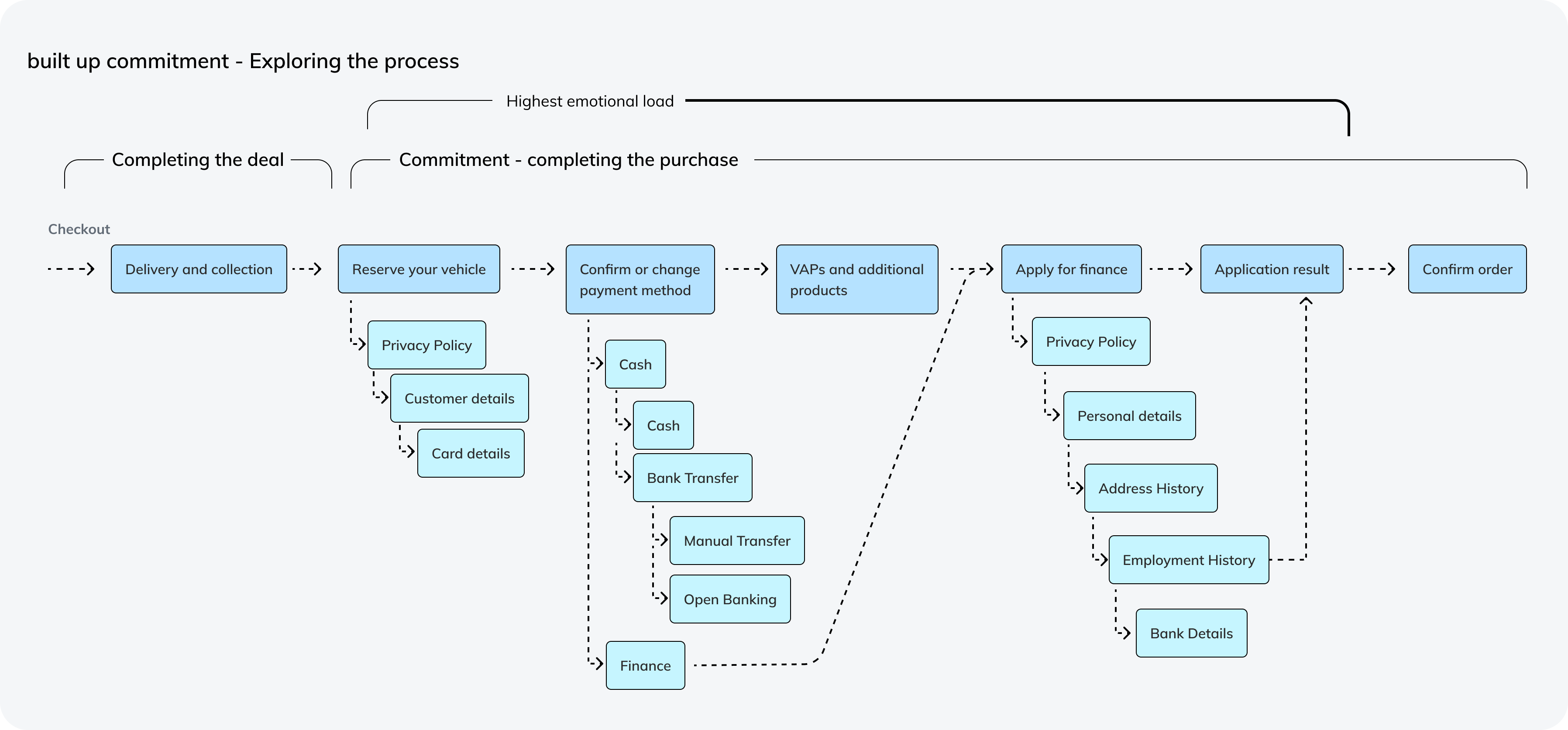
A detail of the flow, showing the tasks that would work better with
this approach.
Results
Higher task success rate on conversational journeys
Reduced form fatigue (measured via completion rates and time-on-task)
Expert users retained access to dense, keyboard-navigable forms
Less than a quarter of users preferred the traditional form for linear tasks, mainly users with a
consolidated experience in the process, but accommodating them was essential.
It's worth noticing that a full order creation process took significantly longer since any question needed to
be separate. The ability to cluster questions, e.g. let the user write their address as they please, and
present them with a technically correct version for them to confirm, makes the process sleeker and increases
the satisfaction, since the system adapts to the user, not vice versa.
Implications for AI interfaces
This tension - efficiency vs. agency - is central to AI product design:
When should AI guide, and when should it step back?
How do you build trust without removing control?
What's the right level of automation for infrequent vs. repeated tasks?
How would the pattern shift due to the increased penetration of large language
models in people’s everyday lives?
Conversational and agentic interfaces may face the same trade-offs. Users may complete tasks faster with AI
assistance but feel less ownership of the outcome. Designing for both behavioural success and reflective
satisfaction requires understanding when each matters most.
As an example, AI could suggest alternative options and conversational paths for information seeking during
the discovery phase would be very beneficial. They could be a great way to enhance the experience by making
the user more in control, while nudging them to explore more.
AI, especially LLMs and hybrid models, have done an incredible evolution in the last few years. The
improvements are exponential, as well as the diffusion of such systems across the consumers.
What we found back in 2019 may need to be revised today, to see if the patterns have shifted. We may discover
that now people would vastly prefer a conversational journey also for discovery and engagement.
What we'd do differently now
Test with users who have higher LLM familiarity.
Measure expectation shift, not just preference.
Explore hybrid patterns: conversational for guidance, traditional for input.
We lived in the “Google” era, where people mostly typed their search on the search bar, if available. The
question is if we are now entering the “conversational” era, where people feel more “natural” to just asking
in plain language what they are looking for. We should find relevant metrics to understand the direction, not
just preferences but familiarity and satisfaction, and of course - it’s a business afterall - conversion rate
variation between the two models.
Design principles for specific products are not necessarily set in stone, they evolve with people's changing
their way to interact with the world.
Keywords: User Experience | AI | Conversational UI | Behavioural Design | Concept Testing |
Service Design | Experimental Approach | Product Strategy